
Key takeaways
- Employees who understand their benefits are four times more likely to feel confident in their plan choices, according to a 2024 HealthEquity survey of more than 600 working Americans.
- Poor benefits literacy leads to real consequences: employees delay care, second-guess their plan decisions, and miss out on cost-saving options like HSA-qualified high-deductible health plans.
- Benefits literacy doesn’t just help employees, 97% of employees who feel well-supported in understanding their benefits plan to stay with their employer for at least two more years.
The summer is ending and benefits teams are turning their attention to open enrollment season. A lot is at stake for employees when picking a health plan, and it’s no surprise that many feel stressed and uncertain when reviewing their options.
HealthEquity is excited to share insightful research and resources to help benefits professionals drive greater employee confidence and satisfaction with their plan choices during open enrollment and throughout the year.
The survey of more than 600 working Americans demonstrates how benefits literacy can:
- Help employees experience less stress
- Impact employee confidence
- Experience better results with their health benefits, including Health Savings Accounts (HSAs)
As you prepare your open enrollment strategies, be sure to check out these survey results for more insight into how better understanding their benefits options can help your people make choices they feel great about.
Why does open enrollment feel so stressful for employees?
Choosing from an array of benefits options for an entire plan year can be a daunting prospect for employees. In the survey, 26% of respondents said choosing a health plan causes them stress. That stress rises for key groups, including employees under age 35 (29%) and Hispanic or Latino employees (31%).
Even when stress isn’t the headline, uncertainty still shows up. Other employees reported some ambivalence about their health plan choices:
- Thirteen percent of employees aren’t confident they chose the right health plan for their needs.
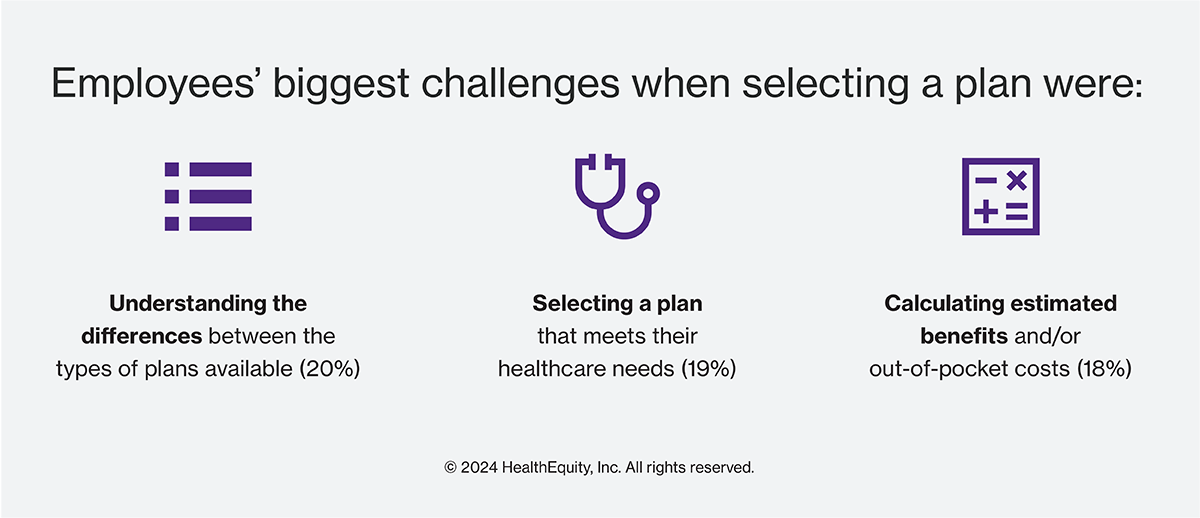
- One in five say they struggle to understand the differences between plan options.
- Nineteen percent worry about choosing a plan that meets their healthcare needs.
- Eighteen percent experience difficulty calculating benefit value or out-of-pocket costs.
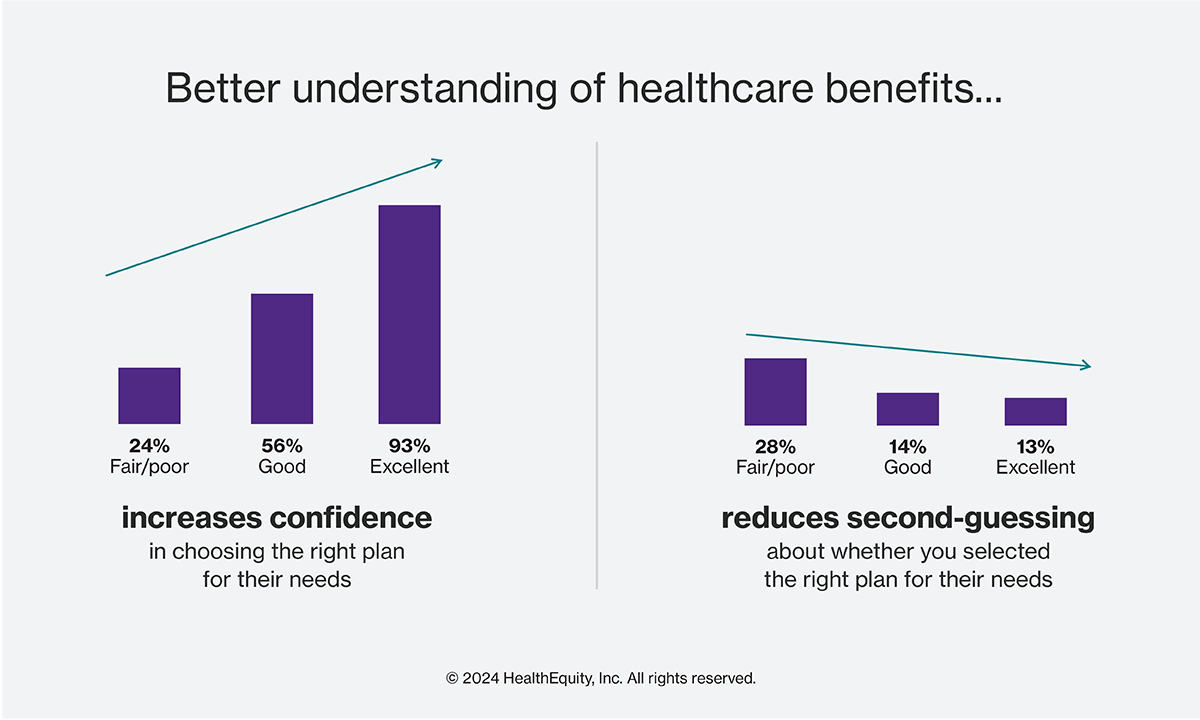
In fact, understanding has a profound impact on how people feel about their choices. Nearly a quarter (24%) of survey respondents who either disagreed they understood their benefits or felt neutral said they were confident about their choice. Among those who strongly agreed they understood their choices, however, 93% felt confident. That means that understanding benefits options made employees roughly four times more likely to feel confident about the plan they elected.
Why do employees skip an HDHP and HSA, even when it could help them?
Because uncertainty often beats potential savings.
A high-deductible health plan (HDHP) paired with an HSA is a powerful benefits option for many people. HDHP premiums are, on average, less expensive than other health plan options, while HSAs provide a way to offset the high deductible and save for healthcare costs in the future.¹ Yet despite the advantages and widespread availability of HSA-qualified HDHPs, some employees forgo the choice.²
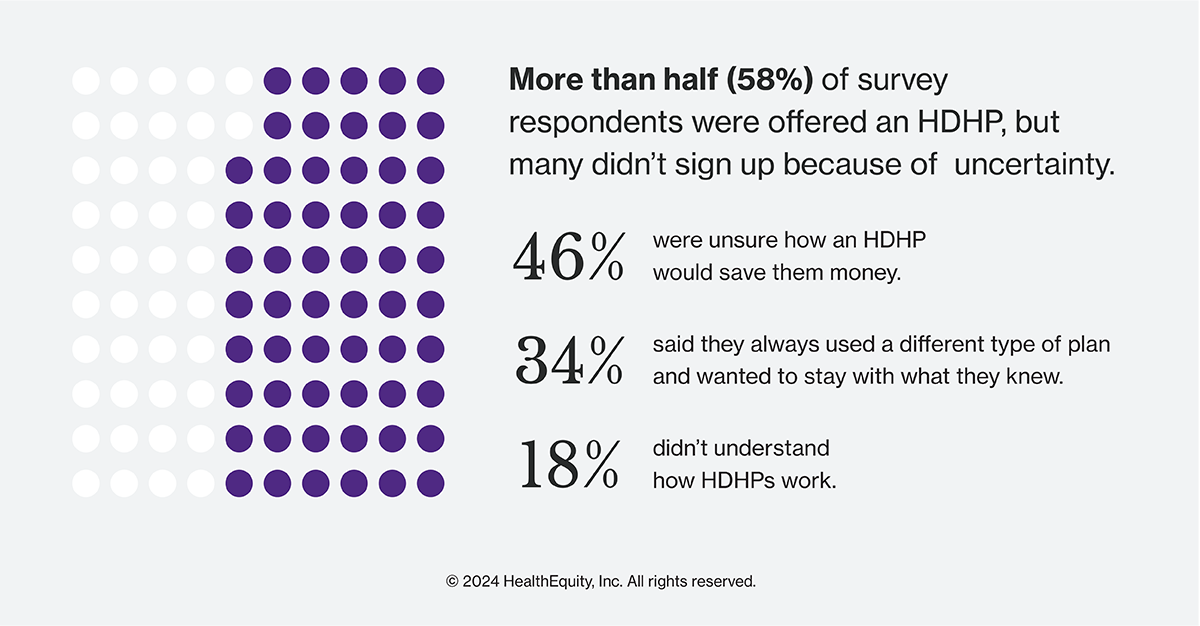
Again, lack of understanding is the most common reason. More than half (58%) of survey respondents were offered an HDHP, but many employees chose not to sign up out of uncertainty.
Among those who didn’t choose an HDHP, respondents cited these top reasons:
That makes for a lot of employees who could be missing out on a great plan option because they simply don’t understand how it works or how it could help them meet their healthcare needs.
How can you reduce second-guessing during the plan year?
These statistics can look daunting for benefits teams. But the remedy is straightforward: promoting better benefits literacy among employees.
When employees understand their benefits, they experience less stress and difficulty while choosing a plan, as well as less second-guessing regarding their decisions during the plan year. Remember, employees who have an excellent understanding of their benefits are four times more confident they chose the right plan when compared with those who have a poor understanding.
Employees who understand their benefits also experience better benefits outcomes. Those who understand their benefits are significantly less likely to take extraordinary measures to manage healthcare costs, such as putting off care.
According to the HealthEquity survey, more than a quarter (28%) of employees who said they have a fair or poor understanding of their benefits also said they’ve second-guessed themselves during the plan year over whether they chose the right plan for their needs. Just 13% of employees who rated their benefits understanding as excellent said the same.
And those with a poor to fair understanding were twice as likely to put off seeking needed care or treatment due to cost than those with an excellent understanding.
Benefits literacy influenced HDHP and HSA consideration as well. Employees who rate their benefits understanding highly were more likely to choose an HDHP paired with an HSA. Nearly 40% of those with an HSA now can’t imagine life without one, and over half (54%) of employees with an excellent understanding of benefits say the same thing.
How does benefits understanding affect employee satisfaction with their employer?
It strengthens trust and improves retention signals.
Better benefits literacy is excellent for employees’ quality of life, it lessens their stress, increases their confidence in their plan selection, and leads to better healthcare outcomes. But it also brings value to their employers.
Employees highly value benefits literacy and the efforts their employers make to improve it. More than half of survey respondents (54%) said their understanding of their health benefits contributed to their overall job satisfaction.
A full 97% of employees who said they’re satisfied with the support they get to understand their benefits also plan to stay with their employer for at least two more years.
Frequently asked questions
References and disclosures
HealthEquity does not provide legal, tax or financial advice.
¹ KFF. (2023). 2023 Employer Health Benefits Survey. Retrieved from: https://www.kff.org/report-section/ehbs-2023-section-1-cost-of-health-insurance/
² KFF. (2023). 2023 Employer Health Benefits Survey. Retrieved from: https://www.kff.org/report-section/ehbs-2023-section-8-high-deductible-health-plans-with-savings-option/