
Key takeaways
- The Spring 2026 Healthcare Affordability Pulse found that 39% of respondents used a payment plan to manage an unexpected medical bill in the past six months, and some plans may introduce interest or fees.1
- A Health Payment Account (HPA) gives employees interest-free, fee-free access to funds for eligible out-of-pocket healthcare costs, with repayment spread over installments.
- HPAs and Health Savings Accounts (HSAs) play complementary roles: HSAs help employees prepare for healthcare expenses over time, while HPAs provide access to funds when costs arrive before savings are ready.
When unexpected healthcare costs arise, employees may not always have enough savings available to cover them. According to HealthEquity's biannual research, the Healthcare Affordability Pulse, 48% of consumers are more concerned about their personal finances than they were six months ago, and 36% say they have delayed or avoided medical care because of cost.1
Now consider what happens when an unexpected medical bill lands on an employee's desk with no warning – and they don't have enough savings to absorb it.
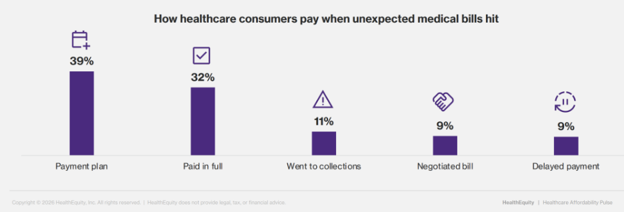
The Healthcare Affordability Pulse found that 39% of consumers used a payment plan to cover an unexpected medical bill in the last six months.1 While healthcare payment plans can help spread out the cost of care, terms can vary. Some hospital and provider payment plans may be interest-free, while others may introduce interest or fees if the balance isn't paid within a specified timeframe.2
This is where Health Payment Accounts (HPAs) come in. HPA gives employees a predictable, interest-free way to pay eligible healthcare expenses.
What is a Health Payment Account (HPA)?
A Health Payment Account (HPA) is an employer-sponsored benefit that gives employees interest-free, no-fee access to funds for eligible out-of-pocket healthcare costs.3 Employees can use an HPA card or digital wallet to pay for medical, dental, vision, prescription, and veterinary expenses, then repay the balance gradually.
Unlike a credit card or a hospital's in-house payment plan, HPAs are built specifically around healthcare affordability. You define the funding model and available credit limit – typically $500, $1,000, $1,500, or $2,000 per participant – and employees get immediate access to those funds whenever an eligible expense arises.
No health plan enrollment is required, so an HPA can support any eligible employee, whether they have a high-deductible health plan (HDHP), a traditional plan, or no medical plan at all.
How do Health Payment Accounts work?
HealthEquity partners with Paytient to offer HPAs to our clients and their employees.3 The process is simple:
- Employees activate their HPA. They sign up through the Paytient portal and, once approved, instantly receive a virtual HPA card.
- They pay for eligible expenses. Employees use the card at checkout for eligible medical, dental, vision, prescription, or veterinary costs for themselves, dependents, or even pets.
- They choose a repayment plan. They can split each balance into an interest-free, fee-free installment plan that fits their budget, with payments deducted automatically from a paycheck, bank account, or HSA.3
Unlike many third-party hospital payment plans, HPAs provide predictable repayment without interest or fees.2
Who is eligible for a Health Payment Account?
Employers can determine HPA eligibility, and membership is tied to continued employment. If an employee leaves your organization, they can no longer make new charges, though they still need to pay any remaining balance under the terms of their cardholder agreement.
Your organization isn't responsible for collecting that balance. Paytient works directly with former employees to arrange repayment.3
How can an HPA help with unexpected healthcare costs?
An HPA gives employees a way to cover an eligible cost they would have needed to pay out-of-pocket without turning to high-interest credit cards, borrowing from family, or hospital/provider payment plans. While it doesn't lower the underlying price of care, it can make the expense more manageable by breaking a lump sum into predictable installments.
For an employee who might otherwise delay treatment, skip a prescription, let a bill go to collections, or drain savings in a single transaction, that structure can make a meaningful difference.
How do HPAs work alongside HSAs?
You don't have to think of HSAs and HPAs as competing tools. They solve two different problems.
A Health Savings Account (HSA) helps eligible employees set aside pre-tax dollars for qualified medical expenses.4 These HSA tax savings are one reason HSAs can be a valuable tool for managing healthcare expenses over time. Funds roll over every year and have the potential to grow through investment.5 Employees contribute a little at a time from each paycheck, alongside employer contributions, building a cushion for routine and future care.
An HPA addresses a different need: access to funds for an eligible expense right now, when an employee hasn't built enough savings yet.
What happens when an unexpected medical expense comes before HSA savings are available?
Without an HPA, that employee might have to dip into personal savings, use a high-interest credit card, borrow from loved ones, or enter an unfamiliar hospital payment plan.
With an HPA, they can cover the eligible out-of-pocket cost immediately and repay it incrementally, interest-free, while keeping their HSA balance intact.5 They can also choose to repay the HPA balance with HSA funds if that makes more sense for their situation.
How can employers support long-term healthcare financial wellness?
HSA holders are 43% more likely to say their healthcare is completely or mostly affordable than those without an HSA.1 But even employees with HSAs can get caught off guard by a large bill early in the plan year.
Building employee healthcare savings can help workers prepare for future medical expenses, but even employees who save consistently can get caught off guard by a large bill early in the plan year.
An HPA can also help employees avoid tapping retirement savings when an unexpected healthcare expense arises. Vanguard research found that hardship withdrawals are increasing, with medical expenses accounting for 31% of hardship withdrawals in 2025.7
Closing the gap between healthcare costs and healthcare savings
HSAs can help employees build savings for future healthcare needs, while HPAs can provide a way to manage unexpected healthcare costs before those savings are ready. Together, they can provide complementary support for healthcare financial readiness.
As you evaluate how to support employees' financial readiness for the year ahead, pairing these two tools can offer a practical way to strengthen your benefits strategy.
Ready to see how an HPA could fit into your benefits lineup? Learn more about HealthEquity Health Payment Accounts.