
Health Plan Enrollment 2023
HSA: The smart choice
Pair your qualifying health plan with a Health Savings Account (HSA) to save on qualified medical expenses and taxes.
How Health Savings
Accounts work
A Health Savings Account lets you set aside pre-tax money for future healthcare costs. HSA contributions can be withdrawn tax-free when used for qualified medical expenses. You can make FDIC eligible, interest-bearing contributions any time and the funds never expire.
An eligible individual:
- •Is covered under a qualified high-deductible health plan (HDHP)
- •Has no other health coverage
- •Is not enrolled in Medicare
- •Cannot be claimed as a dependent on someone else's tax return
Benefits of an HSA
Save up to $1,500 on taxes
Pay medical expenses with tax-free money
Build a safety net for emergencies
Invest your HSA pre-tax, like a 401(k)
Keep your money - funds do not expire
Benefits of a

HSA
All the benefits of an HSA
$0 monthly account fee
Free HealthEquity debit card
FDIC eligible, interest-bearing
Start investing with only $500
What's next
Get an HSA-qualified health plan
When you compare plans on HealthCare.gov, look for the “HSA-eligible” flag in the upper left-hand corner. You can also filter to see only HSA-eligible plans by using the “Filter” option in the right-hand corner.

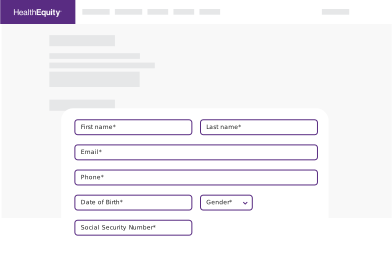
Open a Healthequity HSA
Click the link below, enter your information, and get your personalized individual HSA for $0/month.
Open an HSA todayStart saving
We make it easy to save up to $1,500² on taxes. Once your HSA is open, simply connect your bank account to make tax-deductible contributions, earn tax-free growth, and spend tax-free on qualified expenses with your HealthEquity Visa® debit card.

HSA Contribution Limits
Take your account to the max.
| Tax year | Individual coverage limit | Family coverage limit |
|---|---|---|
| 2026 | $4,400 | $8,750 |
| 2027 | $4,500 | $9,000 |
| Tax year | Individual coverage limit |
|---|---|
| 2025 | $4,300 |
| 2026 | $4,400 |
| Tax year | Family coverage limit |
|---|---|
| 2025 | $8,550 |
| 2026 | $8,750 |
At age 55, members can contribute an additional $1,000 beyond IRS limits.
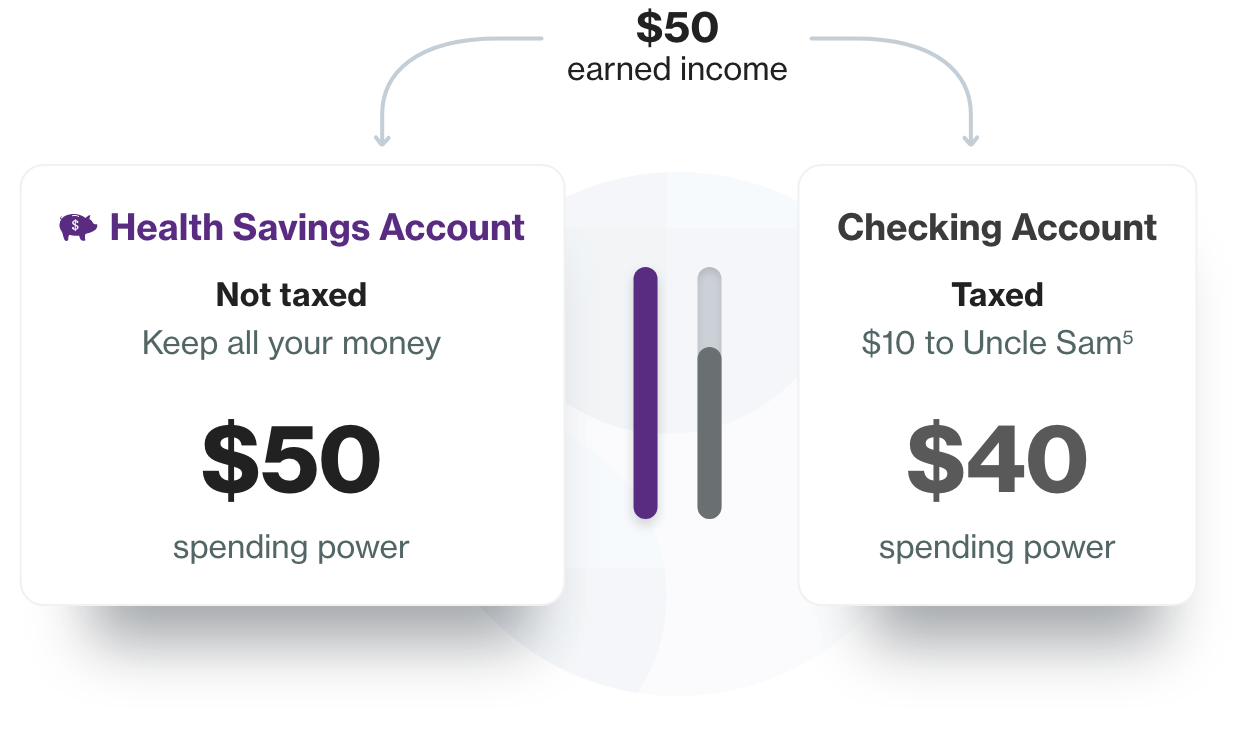
Maximize your spending power
When you use your tax-advantaged HSA, you get $10 in tax savings for every $50 you contribute.5
The more you contribute,
the more you save
Drag the slider to see how more contributions can translate into more HSA tax savings. Example uses a 20% effective rate.2

Annual Contributions
$1,500
Tax Savings
$300

Webinar registration
Check out our library of on-demand webinars – or sign up for weekly live events:
Harness the Power of an HSA
Discover how to use a Health Savings Account (HSA) to save on healthcare premiums and build long-term health savings.
Register todayHSA Your Way
Discover how to use a Health Savings Account (HSA) to save on healthcare premiums and build long-term health savings.
Register todayHSA: The new retirement strategy
Your HSA is like a second 401(k). Join us to find out how to invest your HSA and build the ultimate retirement nest egg.
Register todayTools and resources
Qualified medical expenses
Discover what you can pay for with your tax-advantaged accounts.
See a full listCompare your options
Health Savings Accounts (HSAs), Flexible Spending Accounts (FSAs), and Health Reimbursement Arrangements (HRAs) each let members use tax-advantaged dollars to pay for qualified medical expenses. But there are some important differences to keep in mind.
HSA
- ✓You own your account
- ✓Adjust your contributions anytime, all year
- ✓Your account is investible
- ✓Account carryover - keep your HSA funds forever
FSA
- ✓Account is employer-owned
- ✓Adjust your contributions only during annual enrollment
- ✓Account is not investible
- ✓Limited account carryover
HRA
- ✓Account is employer-owned
- ✓Employer chooses when to adjust contributions
- ✓Account is not investible
- ✓No account carryover


Get 24/7 support
Our Member Services team is available by call or chat 24/7, every day of the year.


About us
Since our founding in 2002, HealthEquity has remained laser-focused on a singular goal: Empower working Americans to gain more choice and control over their healthcare and financial future. By 2030, we plan to make HSAs more common than 401(k)s.
Today 17 million+ members and 120,000+ organizations trust HealthEquity to help them connect health and wealth.6
- HSAs are never taxed at a federal income tax level when used appropriately for qualified medical expenses. Also, most states recognize HSA funds as tax-deductible with very few exceptions. Please consult a tax advisor regarding your state's specific rules. Return to content
- Estimated savings are based on an assumed combined federal and state income tax bracket of 30%. Actual savings will depend on your taxable income and tax status. Return to content
- Investments are subject to risk, including the possible loss of the principal invested, and are not FDIC or NCUA insured, or guaranteed by HealthEquity, Inc. Investing through the HealthEquity investment platform is subject to the terms and conditions of the Health Savings Account Custodial Agreement and any applicable investment supplement. Investing may not be suitable for everyone and before making any investments, you should carefully consider the investment objectives, risks, charges and expenses of any mutual fund before investing. A prospectus and, if available, a summary prospectus containing this and other important information can be obtained by visiting the fund sponsor's website. Please read the prospectus carefully before investing. Return to content
- This card is issued by The Bancorp Bank, N.A. pursuant to a license from Visa U.S.A. Inc. Your card can be used everywhere Visa debit cards are accepted for eligible expenses. This card cannot be used at ATMs and you cannot get cash back, and cannot be used at gas stations, restaurants, or other establishments not health related. For card terms and conditions, see the Cardholder Agreement that is provided with the card. Return to content
- The example(s) used is (are) for illustrative purposes only. Return to content
- As of January 31, 2025, according to a 2025 HealthEquity Year-End Sales Report. Return to content
HealthEquity does not provide legal, tax or financial advice. Always consult a professional when making life-changing decisions.